

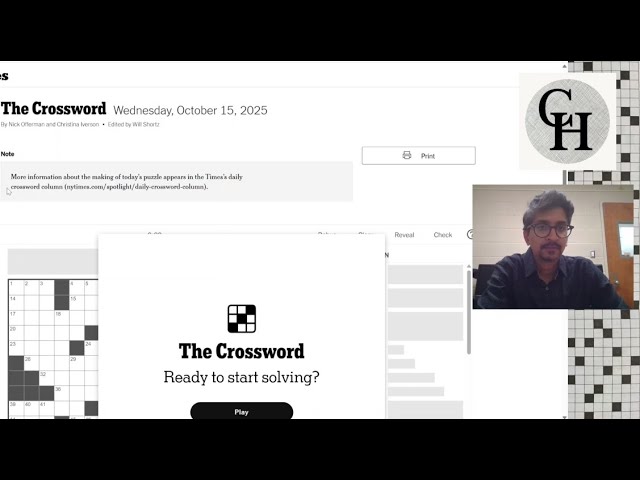
NYTimes Daily Crossword: A Fresh Challenge Every Day
The New York Times Daily Crossword: A Puzzle for Every Day
The New York Times Daily Crossword is one of the best-known word puzzles in the world. Published each day, it invites solvers to fill a grid with answers that cross one another, using a set of clues to uncover words, phrases and, often, a playful theme.
How the puzzle works
Each crossword has numbered Across and Down clues. Every answer must fit its allotted spaces and agree with the letters supplied by intersecting answers. A tricky clue can become easier once a few crossings are in place, making deduction as important as vocabulary.
Many puzzles include a theme: a pattern or idea linking several longer answers. Spotting it can offer a useful nudge, though the theme is not always essential to completing the grid.
Difficulty throughout the week
The weekday puzzles traditionally become more challenging as the week goes on. Monday is generally the gentlest starting point, while Friday and Saturday tend to offer tougher clues, more wordplay and fewer straightforward entries. The Sunday crossword is larger, with a distinctive themed grid; its size does not necessarily make it the hardest puzzle of the week.
Tips for new solvers
- Begin with the clues you know. Short, familiar answers can provide helpful crossing letters.
- Read each clue carefully. A question mark or unusual wording may signal a pun or another kind of wordplay.
- Use crossings to check your ideas. If an answer creates several unlikely letters elsewhere, reconsider it.
- Think about the day of the week. A clue’s style and difficulty may reflect the puzzle’s place in the weekly sequence.
- Take a break when needed. Returning with fresh eyes can make an answer suddenly apparent.
Print and digital solving
The crossword is available in print and through The New York Times’ digital platforms. Digital tools can make it convenient to enter answers, check progress and return to a puzzle later. Features and access requirements may vary, so it is worth checking the newspaper’s current subscription options and app details.
Whether solved over breakfast, during a commute or as part of an evening routine, the NYT Daily Crossword offers a satisfying mix of language, logic and discovery. Its familiar format makes it easy to pick up, while the changing clues and themes give regular solvers a fresh challenge each day.
Mastering the NY Times Daily Crossword: 8 Essential Tips for Success
- Start with the clues you know.
- Use crossing answers to check tricky words.
- Try every clue in both directions.
- Look for common crossword abbreviations.
- Watch for puns and misleading wording.
- Skip tough clues and return later.
- Check spelling before submitting.
- Practise regularly to spot recurring themes.
Start with the clues you know.
Start with the clues you know to build momentum and fill in the easiest answers first. Each completed word gives you crossing letters that can reveal answers to trickier clues, so even a few confident entries can help unlock much more of the New York Times Daily Crossword.
Use crossing answers to check tricky words.
Use crossing answers to check tricky words: when a clue has you stumped, solve the Across or Down entries that intersect it and use their letters to narrow down the possibilities. These crossing letters can confirm a guess or reveal that you need to rethink it, helping you work through the puzzle without relying on guesswork alone.
Try every clue in both directions.
Try every clue in both directions: if an Across answer has you stumped, work on the Down clues that cross it, and vice versa. Even a couple of confirmed letters can reveal the word you’re looking for, while an answer that clashes with several crossings is a useful sign to rethink your guess. This simple back-and-forth approach can help you make steady progress through the NYT Daily Crossword without getting stuck on a single clue.
Look for common crossword abbreviations.
Look out for common crossword abbreviations: clues may signal that an answer should use a shortened form rather than a full word. For example, “company” might point to “Co.”, “street” to “St”, or “doctor” to “Dr”. Clue wording such as “briefly”, “for short” or “abbr.” can be a helpful hint, and the crossing letters will help confirm whether you have the right abbreviation.
Watch for puns and misleading wording.
Watch for puns and misleading wording: crossword clues often use playful phrasing, double meanings or a deliberately unexpected interpretation. If an answer seems obvious but does not fit the crossing letters, pause and consider whether the clue could mean something different. A question mark can be a useful hint that wordplay is involved.
Skip tough clues and return later.
If a clue has you stumped, skip it and move on to one that feels more manageable. Filling in easier answers can reveal crossing letters, giving you fresh hints when you return to the tricky clue. This keeps your solving momentum going and can make even the most challenging parts of the NYT Daily Crossword easier to crack.
Check spelling before submitting.
Before submitting your NYT Daily Crossword, check the spelling of every answer carefully. A single incorrect letter can affect several crossing words, so review any entries that seem uncertain and use the intersecting clues to confirm them. Pay particular attention to unfamiliar names, abbreviations and tricky wordplay.
Practise regularly to spot recurring themes.
Practising the NYT Daily Crossword regularly can help you recognise recurring themes, clue styles and wordplay. The more puzzles you solve, the easier it becomes to notice familiar patterns and use them to work out answers you might otherwise miss.