

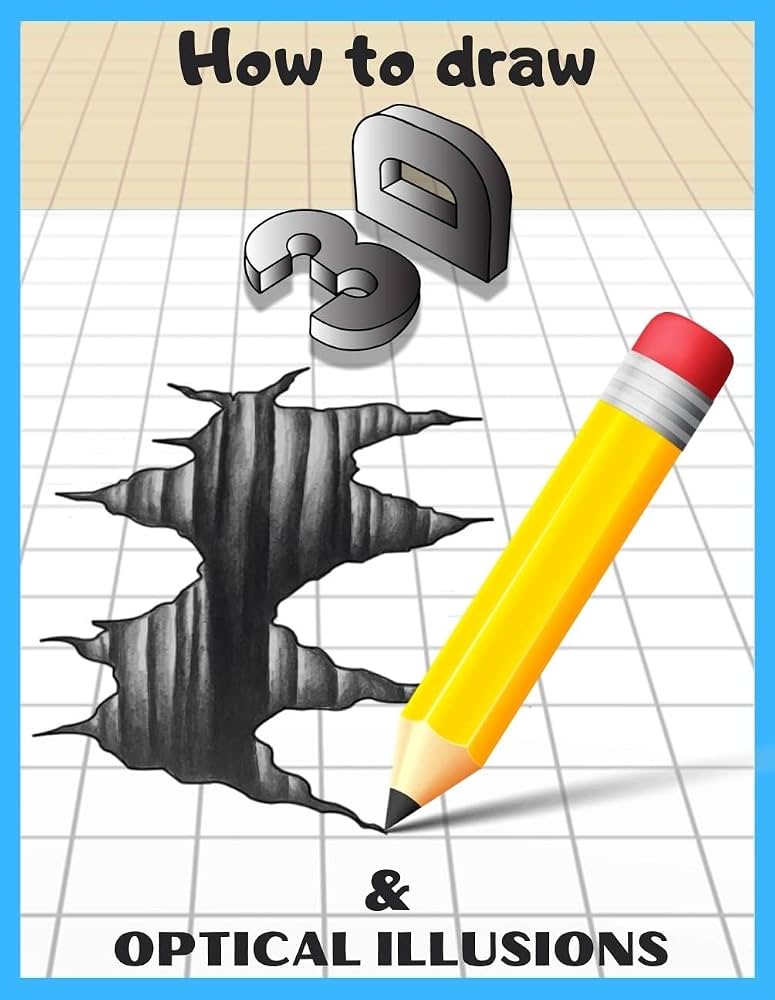
How to Create a Drawing of an Optical Illusion
How to Draw an Optical Illusion
An optical illusion drawing plays with the way the eye and brain interpret shapes, lines, colour and perspective. A flat page can appear to bulge, twist or contain a hole simply by arranging marks in a clever way. You do not need specialist equipment to try one: a pencil, ruler and a few colouring materials are enough to get started.
Try a simple 3D hole illusion
This design uses curved lines and shading to make a flat sheet of paper look as though it dips into a deep hole.
- Draw a grid. Use a ruler to make a light grid of evenly spaced squares across the page.
- Mark the centre. Choose a point near the middle of the grid as the centre of the illusion.
- Curve the lines. Redraw the straight grid lines so that they bend towards the centre. Keep the curves smooth and gradual; the squares should look stretched around the middle.
- Strengthen the pattern. Go over the lines with a darker pencil or pen. Varying the line weight slightly can help the drawing feel more dimensional.
- Add shading. Shade the areas near the centre more heavily, then gradually lighten the shading towards the edges. This contrast suggests depth.
- Add colour if you like. Alternate colours between the sections, or use different shades of one colour. Keep the pattern consistent so the illusion remains clear.
Once the drawing is complete, look at it from a short distance. The curved grid and darker centre can make the page seem to sink inwards. If the effect is subtle, deepen the contrast or make the lines curve more noticeably.
Why does the illusion work?
The brain uses clues such as shading, contrast and perspective to work out whether a shape is flat or three-dimensional. In an optical illusion drawing, these clues are arranged in an unexpected way. The eye follows the curved lines, while the darker centre suggests a change in depth. Together, they can make a flat pattern appear to bend or recede.
Tips for better results
- Draw lightly at first so you can adjust the pattern before adding darker lines.
- Keep spacing as even as possible around the centre.
- Use strong differences between light and dark areas to make the effect easier to see.
- Experiment with different shapes, colours and viewpoints.
Optical illusion drawings are a fun way to explore how perception works. Start with a simple grid, then change the curves and shading to see how small adjustments affect the final image. With practice, you can create patterns that seem to move, twist or extend beyond the page.
Exploring Optical Illusions: Top Questions and Techniques for Drawing Mind-Bending Art
- What is the coolest optical illusion?
- What are the top 10 most famous optical illusions?
- What are the 3 main optical illusions?
- How to do a 3D illusion?
- How to create an illusion drawing?
- What is optical illusion drawing?
- How do I draw an optical illusion step-by-step?
What is the coolest optical illusion?
The “coolest” optical illusion is a matter of personal taste, but the impossible triangle is a popular favourite. Its connected bars seem to form a solid three-dimensional shape, yet the joins cannot exist in the way they appear on the page. It is also fun to draw: use a ruler to create three angled sections, then carefully adjust the overlaps so each part seems to pass both in front of and behind another. The result is a simple drawing that makes viewers pause and look twice.
What are the top 10 most famous optical illusions?
Some of the world’s best-known optical illusions include the Müller-Lyer illusion, in which arrow-like ends make equal lines appear different in length; the Ponzo illusion, where converging lines affect how we judge size; the Ebbinghaus illusion, which changes how large a circle seems depending on the circles around it; and the checker-shadow illusion, which shows how context can alter our perception of brightness. Other famous examples are the Necker cube, the Rubin vase, the Kanizsa triangle, the rotating snakes illusion, the impossible trident and the Café Wall illusion. These designs reveal how the brain interprets visual cues—and make excellent inspiration for anyone drawing an optical illusion.
What are the 3 main optical illusions?
The three main types of optical illusions are literal, physiological and cognitive. Literal illusions create an image that differs from the objects used to make it, such as a drawing that appears to show one shape but can be seen as another. Physiological illusions arise when the eyes are overstimulated by patterns, colour, brightness or movement, while cognitive illusions occur when the brain interprets an image in more than one way or makes assumptions about depth and perspective. These categories can overlap, and artists often use their features to create drawings that seem to move, change shape or appear three-dimensional.
How to do a 3D illusion?
To create a 3D illusion, draw a simple shape or grid in pencil, then use perspective, curved lines and shading to make it appear to have depth. For example, sketch a grid and bend its lines towards a central point, keeping the spacing consistent. Add darker shading near the centre and lighter tones towards the edges to suggest a dip or raised surface. Strong contrast and careful line work help the effect stand out.
How to create an illusion drawing?
To create an illusion drawing, start with a simple design, such as a curved grid or a pattern of repeating shapes. Sketch it lightly in pencil, using a ruler to keep lines and spacing even, then add curves, shading and contrasting colours to suggest depth or movement. Optical illusions rely on visual clues that make a flat image appear three-dimensional, so experiment with light and dark areas and view your drawing from different distances.
What is optical illusion drawing?
An optical illusion drawing is an image designed to trick or surprise the eye by using patterns, lines, shading, colour or perspective. Although it is usually flat, it may appear to move, change shape or have depth. These drawings show how the brain interprets visual clues—and how a creative arrangement of those clues can make us see something unexpected.
How do I draw an optical illusion step-by-step?
To draw a simple optical illusion, start by sketching a light grid of evenly spaced squares with a ruler. Mark a centre point, then gently curve the grid lines towards it, keeping the pattern symmetrical. Trace over the lines more firmly and add shading, using darker tones near the centre and lighter ones towards the edges to suggest depth. You can also colour alternate sections to make the effect stand out. Take a step back to view your drawing, and adjust the curves or contrast until the flat pattern appears to bend or recede.